
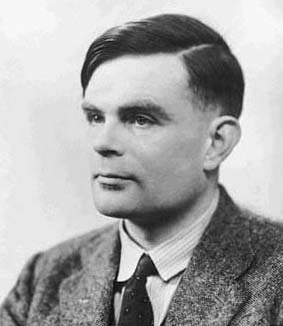
 After the unequivocal apology to wartime code breaker Alan Turing by the British government, prosecuted for his homosexuality in 1952, Bletchley Park Trust has urged the nation to support its preservation as a permanent tribute to the legacy of Turing and the thousands who worked there, providing vital intelligence gathering during the Second World War.
Turing, who committed suicide in 1954, was, among other things a mathematician, logician, cryptanalyst, and computer scientist. He's been described by his biographer Andrew Hodges as the founder of computer science, mathematician, philosopher, codebreaker, strange visionary and a gay man before his time - the latter to prove his downfall at a time when homosexuality was illegal and considered to be a mental illness during his lifetime.
Influential in the development of computer science, Turing provided an influential formalisation of the concept of the algorithm and computation with the Turing machine. In 1999 Time Magazine named him as one of the 100 Most Important People of the 20th Century for his role in the creation of the modern computer and his Turing test is regarded as a significant and characteristically provocative contribution to the debate regarding artificial intelligence.
The work done by Turing and the codebreakers at Bletchley Park was utterly fundamental to the allied victory and freedom in the west. The contribution of Alan Turing himself cannot be exaggerated – he illuminated the whole of the cryptographic work undertaken at Bletchley Park and stands alongside wartime Prime Minister Winston Churchill as a truly great Briton.
Turing was a very well-liked but incredibly shy and eccentric man. In 1952, he was prosecuted for his homosexuality and accepted treatment with female hormones as an alternative to going to prison.
At his trial, two of his fellow codebreakers, Max Newman and Hugh Alexander, stood alongside him in support.
Prime Minister Gordon Brown has now issued an unequivocal apology for the way Turing was treated.
"Turing was a quite brilliant mathematician, most famous for his work on breaking the German Enigma codes," notes Brown in the apology. "It is no exaggeration to say that, without his outstanding contribution, the history of World War Two could well have been very different... The debt of gratitude he is owed makes it all the more horrifying, therefore, that he was treated so inhumanely. In 1952, he was convicted of ‘gross indecency’ - in effect, tried for being gay. His sentence - and he was faced with the miserable choice of this or prison - was chemical castration by a series of injections of female hormones. He took his own life just two years later.
"Thousands of people have come together to demand justice for Alan Turing and recognition of the appalling way he was treated. While Turing was dealt with under the law of the time and we can’t put the clock back, his treatment was of course utterly unfair and I am pleased to have the chance to say how deeply sorry I and we all are for what happened to him. Alan and the many thousands of other gay men who were convicted as he was convicted under homophobic laws were treated terribly. Over the years millions more lived in fear of conviction.
"... on behalf of the British government, and all those who live freely thanks to Alan’s work I am very proud to say: we’re sorry, you deserved so much better." (read the full statement here)
“The government apology is a landmark in recognising the contribution of Turing and Bletchley Park to the way we all live today," Simon Greenish, director of the Bletchley Park Trust comments. "It's important that as a nation, we celebrate the achievements of Turing and his fellow codebreakers and ensure that Bletchley Park is preserved as a permanent tribute to their legacy”.

Located near Milton Keynes, its modern day activities funded by the Bletchley Park Trust, the wartime codebreaking site is host to the Nazi Enigma Machines, including the rare 'Abwehr G312', considered a highlight of a busy day out at Bletchley Park, but there is much more than machines in a visit to the historic site. You can check out the tales of spies and strategic deception and you may even be the one to discover the map to genius mathematician Alan Turing's silver, supposedly buried in or near Bletchley Park.
There are more than enough different activities and exhibitions to occupy most families for a whole day, from wartime toys to working computers, a wartime mini cinema and an outstanding Churchill collection.
• Bletchley Park is open every day except Christmas Eve, Christmas Day, Boxing Day and New Years Day. For Bletchley Park visitor information, call 01908 640404, info@bletchleypark.org.uk, or go to www.bletchleypark.org.uk
• The cost of an Annual Season Ticket is: adults £10, concessions £8 (OAPs and student with valid ID card), children £6 (aged 12 to 16 - children under 12 admitted free of charge) and a family ticket £22.50 (two adults and two children aged 12 to 16). Tickets include a guided tour (subject to availability) and/or the use of an audio guide. On-site parking is £3 per car.
• Read the Government apology
• alanturing.net
The Turing Archive for the History of Computing
• The Alan Turing ScrapBook
• The Alan Turing Home Page
Maintained by Turing's biographer, Andrew Hodges


No comments:
Post a Comment