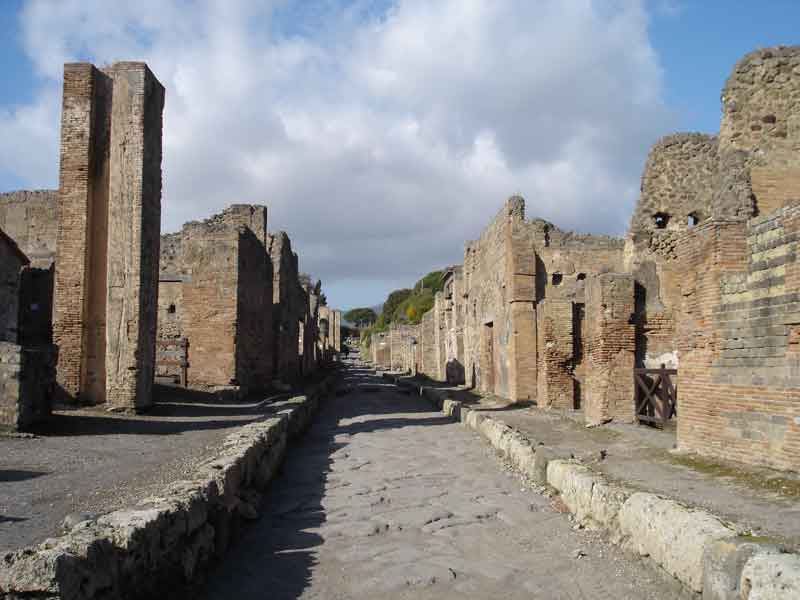
It's not the same as visiting the actual site itself, which take it from me, is simply stunning (as you can see from my holiday snap, above), but Pompei has now joined the cities and towns that have been mapped by Google's StreetView.
Working with UNESCO, Google have announced an agreement to put imagery of World Heritage sites into Street View from 19 UNESCO sites has been made available, from sites in Czech Republic, France, Italy, Netherlands, Spain and the United Kingdom. The 360 degree images are now online for people around the world to explore via
Google Maps - including Pompeii.
Google and UNESCO have also announced layers for Google Earth and Google Maps with customised icons and information bubbles, allowing web users to locate and zoom to hundreds of sites with World heritage status around the globe, all linking back to UNESCO's detailed webpage.
In the coming months Google will work with UNESCO to select additional World Heritage landmarks, in countries where Street View imagery is being collected, which will be photographed for the project. The aim is to collect imagery from diverse regions throughout the world including Australia, Brazil, Canada, Japan, Mexico, South Africa, US and many countries throughout Europe. With permission from site managers such places look set to one day be available to millions of people around the world who may never have the chance to visit them in person.
It's hoped that putting UNESCO's world heritage sites on Street View will help increase awareness and encourage participation by people around the world in the preservation of our cultural and natural heritage.
People can now virtually swoop over to Italy to explore the two flourishing Roman towns of Pompei and Herculaneum, as well as the many wealthy villas in the area that have been engulfed by Vesuvius eruption on 24th August AD 79. These have been progressively excavated and made accessible to the public since the mid-18th century and are now available for all with a simple click of a mouse, although, having tried it, the level of detail is, as yet, nowhere as impressive as the company's PR claims and you definitely can't play 'spot the lizard'...
Stonehenge, in Wiltshire, one of the most famous groups of megaliths in the world is another location that can be discovered today. The circles of menhirs are arranged in a pattern whose astronomical significance is still being explored. These holy places and the nearby Neolithic sites are an incomparable testimony to prehistoric times.
They can also walk through the Palace of Versailles which was the principal residence of the French kings from the time of Louis XIV to Louis XVI. Embellished by several generations of architects, sculptors, decorators and landscape architects, it provided Europe with a model of the ideal royal residence for over a century.
Other unique and diverse places visible in Street View include the Mill Network at Kinderdijk-Elshout in Nederland, the old town of Cáceres in Spain and the historic Centre of Prague in Czech Republic and many more.
Google uses state of the art camera technology attached to the roof of a car in order to collect these images. They are then processed, stitched together and put into Google Maps, a process which can take several months. Where access by car is not possible, or locations are off the beaten track, like Pompeii or Britain's Stonehenge, Google uses its custom made 'trike' - a three wheeled bike mounted with a camera, to take the images.
"World Heritage is our legacy from the past, what we live with today, and what we pass on to future generations,” said Francesco Bandarin, Director of UNESCO’s World Heritage Centre. "It reminds us of the extraordinary world we live in, and humanity’s creative genius and cultural diversity.
"The alliance between UNESCO and, Google Maps and Street View will provide access for people the world over to these remarkable places."
"Cultural and natural heritage sites are a source of inspiration and fascination for all of us, teaching us about our global history," Carlo D'Asaro Biondo, Google's VP of Southern Europe, Middle East & Africa said. "This is an exciting project and we're thrilled to be working together with UNESCO, to make more World Heritage sites universally accessible and useful to all."
• Tour the UNESCO heritage sites in Street View here: www.google.com/unesco