
 |
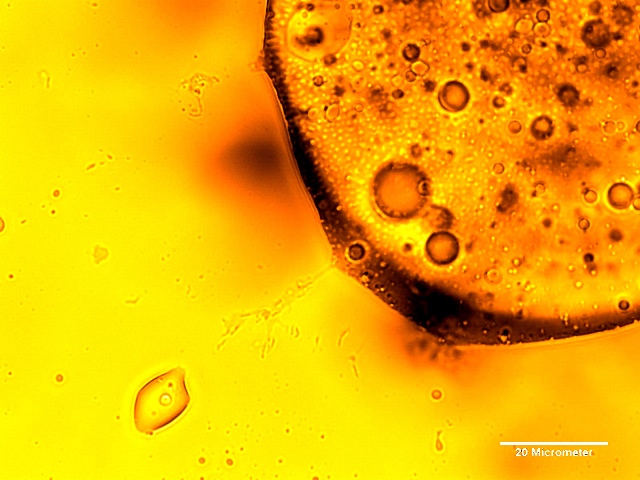
| Microbes are degrading oil in the deepwater plume from the BP oil spill in the Gulf, a study by Berkeley Lab researchers has shown. Image: Hoi-Ying Holman group |
Now, an intensive study by scientists with the Lawrence Berkeley National Laboratory (and indirectly funded by BP) has found that microbial activity, spearheaded by a new and unclassified species, degrades oil much faster than anticipated. This degradation appears to take place without a significant level of oxygen depletion.
This would appear to suggest that, although oxygen has been depleted in the oil spill area, the feared “dead-zones” in the water column it might lead to have not yet occurred.
“Our findings show that the influx of oil profoundly altered the microbial community by significantly stimulating deep-sea psychrophilic (cold temperature) gamma-proteobacteria that are closely related to known petroleum-degrading microbes,” says Terry Hazen, a microbial ecologist with Berkeley Lab’s Earth Sciences Division and principal investigator with the Energy Biosciences Institute, who led this study.
“This enrichment of psychrophilic petroleum degraders with their rapid oil biodegradation rates appears to be one of the major mechanisms behind the rapid decline of the deepwater dispersed oil plume that has been observed.”
The uncontrolled oil blowout in the Gulf of Mexico from BP’s deepwater well was the deepest and one of the largest oil leaks in history. The extreme depths in the water column and the magnitude of this event posed a great many questions. In addition, to prevent large amounts of the highly flammable Gulf light crude from reaching the surface, BP deployed an unprecedented quantity of the commercial oil dispersant Corexit 9500 at the wellhead, creating a plume of micron-sized petroleum particles.
Although the environmental effects of Corexit, a product created by Illinois-based company Nalco, have been studied in surface water applications for more than a decade, its potential impact and effectiveness in the deep waters of the Gulf marine ecosystem were unknown.
Over five million liters of dispersants have been used to break up the Gulf oil spill and Corexit is the most-used dispersant, with COREXIT 9527 having been replaced by COREXIT 9500 after the former was deemed too toxic. Oil that would normally rise to the surface of the water is broken up by the dispersant into small globules that can then remain suspended in the water.
Analysis by Hazen and his colleagues of microbial genes in the dispersed oil plume revealed a variety of hydrocarbon-degraders, some of which were strongly correlated with the concentration changes of various oil contaminants. Analysis of changes in the oil composition as the plume extended from the wellhead pointed to faster than expected biodegradation rates with the half-life of alkanes ranging from 1.2 to 6.1 days.
“Our findings, which provide the first data ever of microbial activity from a deepwater dispersed oil plume, suggest that a great potential for intrinsic bioremediation of oil plumes exists in the deep-sea,” Hazen says.
“These findings also show that psychrophilic oil-degrading microbial populations and their associated microbial communities play a significant role in controlling the ultimate fates and consequences of deep-sea oil plumes in the Gulf of Mexico.”
The results of this research were reported in the journal Science (26th August 2010 on-line) in a paper titled “Deep-sea oil plume enriches Indigenous oil-degrading bacteria.” Hazen and his colleagues began their study on 25th May. At that time, the deep reaches of the Gulf of Mexico were a relatively unexplored microbial habitat, where temperatures hover around 5 degrees Celsius, the pressure is enormous, and there is normally little carbon present.
“We deployed on two ships to determine the physical, chemical and microbiological properties of the deepwater oil plume,” Hazen says. “The oil escaping from the damaged wellhead represented an enormous carbon input to the water column ecosystem and while we suspected that hydrocarbon components in the oil could potentially serve as a carbon substrate for deep-sea microbes, scientific data was needed for informed decisions.”
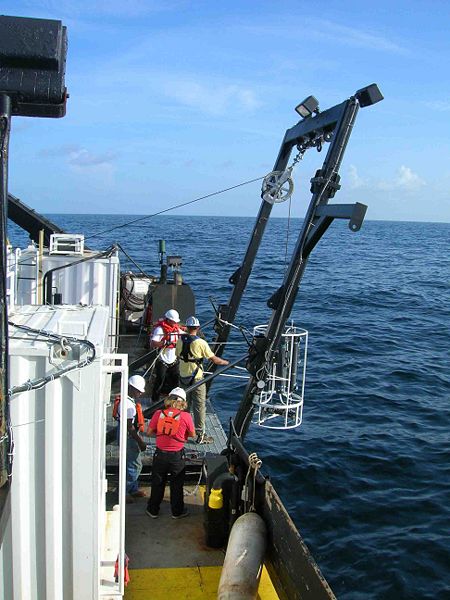 |
| Berkeley Lab researchers collected more than 200 samples from 17 deepwater sites around the damaged BP wellhead in the Gulf of Mexico between May 25 and June 2, 2010. Image: Terry Hazen group |
EBI is a partnership led by the University of California Berkeley and including Berkeley Lab and the University of Illinois that is funded by a $500 million, 10-year grant from BP.
Results in the Science paper are based on the analysis of more than 200 samples collected from 17 deepwater sites between 25th May and 2nd June 2010. Sample analysis was boosted by the use of the latest edition of the award-winning Berkeley Lab PhyloChip – a unique credit card-sized DNA-based microarray that can be used to quickly, accurately and comprehensively detect the presence of up to 50,000 different species of bacteria and archaea in a single sample from any environmental source, without the need of culturing.
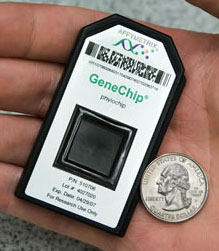 |
| The latest version of the Phylochip designed in conjunction with Lawrence Berkeley Lab |
Use of the Phylochip enabled Hazen and his colleagues to determine that the dominant microbe in the oil plume is a new species, closely related to members of Oceanospirillales family, particularly Oleispirea antarctica and Oceaniserpentilla haliotis.
Hazen and his colleagues attribute the faster than expected rates of oil biodegradation at the 5 degrees Celsius temperature in part to the nature of Gulf light crude, which contains a large volatile component that is more biodegradable.
The use of the Corexit dispersant may have also accelerated biodegradation because of the small size of the oil particles and the low overall concentrations of oil in the plume. In addition, frequent episodic oil leaks from natural seeps in the Gulf seabed may have led to adaptations over long periods of time by the deep-sea microbial community that speed up hydrocarbon degradation rates.
One of the concerns raised about microbial degradation of the oil in a deepwater plume is that the microbes would also be consuming large portions of oxygen in the plume, creating so-called “dead-zones” in the water column where life cannot be sustained. In their study, the Berkeley Lab researchers found that oxygen saturation outside the plume was 67 per cent while within the plume it was 59 per cent.
“The low concentrations of iron in seawater may have prevented oxygen concentrations dropping more precipitously from biodegradation demand on the petroleum, since many hydrocarbon-degrading enzymes have iron as a component,” Hazen says. “There’s not enough iron to form more of these enzymes, which would degrade the carbon faster but also consume more oxygen.”
Despite this apparently good news, the concerns about the massive use of dispersants remains. An article in Scientific American published in June notes that both types of the dispersal compound Corexit used in the Gulf are capable of killing or depressing the growth of a wide range of aquatic species, ranging from phytoplankton to fish. "It's a trade-off decision to lessen the overall environmental impact," explained marine biologist Jane Lubchenco, director of the National Oceanic and Atmospheric Administration, at a press conference on 12th May. "When an oil spill occurs, there are no good outcomes."
An article in the Christian Science Monitor notes that the US Environmental Protection Agency lists 12 other types of dispersants as being more effective in dealing with oil in a way that is safe for wildlife. One of those tested was Dispersit, which an item in Wired says is 100% effective in dispersing Gulf oil and is less toxic to silverfish and shrimp Corexit.
• Visit the Berkeley Lab website at http://www.lbl.gov
• Nalco has more information about the use of Corexit products in the Gulf oil spill here.
• Scientific American, 18th June 2010: Is Using Dispersants on the BP Gulf Oil Spill Fighting Pollution with Pollution?
